











Certified Divorce Decree
Translation
Whoever is reading it – a register office before a new marriage, a visa caseworker, a court – is looking for one thing above all: that the divorce is final and legally effective, and on what date it became so. A translation that blurs that point causes delays.
So the whole judgment is translated, including the court, the case number, the operative part, the date it took effect and any finality or enforceability stamp added afterwards – which in many countries is the part that actually matters.
WHAT THE HOME OFFICE asks for
This is the requirement in the Home Office’s own words, and it is the standard every certified translation we issue is built to meet:
Where documents provided are not in English or Welsh, you must provide a full dated and signed translation in English that can be verified. This must be dated and include the full name and signature of the translator or an authorised official of the translation company and their contact details.
UK Home Office guidance, gov.uk
Read it closely and it is a short list: a full translation, not a summary; in English; dated; signed; with the translator or an authorised official of the translation company named; and with contact details so it can be verified. Every one of those is on the certification page we issue with your divorce decree.
WHAT YOU GET with every certified translation
- Accredited and sworn, fully bilingual philologist and linguist human translators
- An additional native-speaking proofreader on every project for quality assurance
- Professional DTP editing and formatting, so the translation mirrors your original
- A signed affidavit and declaration of translation accuracy
- The company wet stamp for authenticity
- Official certification on company letterhead
- Full compliance with the ISO 17100 quality standard
- A physical copy with wet stamps and company letterhead where one is needed
- Nothing of yours has to travel – a scan is enough, and hard copies come to you
- Any iterations, corrections and editing free of charge, same day or next day
WHEN YOU NEED a certified divorce decree translation
Giving notice of a new marriage
A register office will not accept notice until it is satisfied a previous marriage has legally ended, and it needs the evidence in English.
A spouse or partner visa
Where either party has been married before, the Home Office asks for the divorce document as well as the new marriage certificate.
Changing your name back
HM Passport Office, the DVLA and banks accept a certified translation of the decree as evidence.
Court and family proceedings
HM Courts & Tribunals Service requires a certified English translation of a foreign judgment filed in proceedings.
Property and financial settlement
Solicitors, conveyancers and lenders need the terms of the settlement in English.
Recognition of the divorce abroad
Where the divorce has to be recognised in another country, the translation is usually apostilled as well.
WHO ACCEPTS it
Issued to the standard the Home Office publishes, and routinely accepted by:
- The Home Office and UKVI
- HM Courts & Tribunals Service
- The General Register Office and local register offices
- HM Passport Office
- The DVLA
- Solicitors, notaries and conveyancers
- Banks and mortgage lenders
- Foreign embassies and consulates in the UK
If the body you are dealing with is not on this list, ask us before you order – checking what they actually require is free, and it is the fastest way to avoid paying for a level of certification you do not need.
THINGS PEOPLE get caught out by
The finality stamp is the point
In many jurisdictions the judgment only becomes effective once a separate legal-force or finality endorsement is added, often weeks later and often on the reverse. Photograph the back of every page – that endorsement is what a register office is looking for.
Decree absolute, not decree nisi
The English terms changed in 2022: a final order replaced the decree absolute, and a conditional order replaced the decree nisi. Foreign judgments have their own equivalents, and we translate the terminology so a UK reader can tell which stage it represents.
Every page, including the reasoning
Some courts want the whole judgment rather than the operative paragraph. Send all of it; we will quote on the whole and tell you if a shorter extract would do.
Recognition is a separate question
Translating the decree is not the same as the divorce being recognised in the UK, which is a legal matter for a solicitor. We can tell you what translation and certification will be wanted; we cannot advise on recognition.
HOW IT works
Send a scan
A photograph from your phone is fine, as long as every corner is in frame and the text, the stamps and anything written on the back are readable. Your original never leaves you.
Get a fixed price
We read the document, confirm the language and the certification the receiving body wants, and send back an itemised price and a delivery date. Free, and with no obligation.
Translation and checking
An accredited, sworn linguist translates it; a second linguist who is a native speaker of the target language reads the whole thing against the source.
Certification
The translation is issued with a signed declaration of accuracy on company letterhead, dated, with the translator named and our wet stamp applied.
Delivery
By email the day it is finished, with a wet-stamped hard copy posted to your address if you need one. Corrections afterwards are free.
The full five-stage service process, and the three-stage quality assessment behind it, are set out on How It Works and Quality Assurance.
PRICE AND turnaround
PriceQuoted per job
A standard divorce decree is priced per document with certification included, and a posted hard copy is priced per page. You get the figure in writing, itemised and fixed, before you commit – and the analysis that produces it is free.
Standard24–72 hours
One to three working days for a standard certificate, in any of the 76 languages we work in.
ExpeditedAs fast as 24h
When a deadline is close – without taking the second linguist out of the process.

0 +Years of Excellence
0 +Happy Customers
0 +Official Translators
0 Countries Approved EKO 4's Certified Translations
At EKO 4 Translations we guarantee 100%
- Document Acceptance
- Accuracy and Quality
- Delivery on Time
- Free Corrections
WHAT ELSE your document might need
A certified translation is enough for most UK purposes. Documents going abroad, or to a body that has asked for a solicitor or notary, need a layer on top – and it is ordered with the translation rather than afterwards.
Certified translation
The full service and what it covers – 114 document types, 76 languages, and what certification actually is.
Certified document translation →Sworn & notarised
When an authority wants the declaration sworn before a solicitor, or witnessed and sealed by a notary.
Sworn & notarised translation →Apostille & legalisation
For documents going abroad: an FCDO certificate on the translation we prepared, plus embassy legalisation where it is needed.
Apostille & legalisation →76 languages
The full European and Asian lists. The language changes who does the work, not what you get.
Translation languages →Some of our clients
















As featured on
















DIVORCE DECREE questions, answered
Will a register office accept this before I remarry?
Yes – that is one of the commonest reasons this document is translated. It carries a dated declaration of accuracy, the translator named and signed, our contact details, company letterhead and our wet stamp, which is what register offices ask for.
Do you translate the whole judgment or just the decision?
Whatever the receiving body wants. Many accept the operative part plus the finality endorsement; some want every page. Tell us who it is for and we will quote for the right scope rather than the largest one.
What if the finality stamp is on the back?
Photograph the back as well and send it with the rest. That endorsement is frequently the whole point of the document, and a translation without it is often rejected.
How much and how fast?
Court judgments run a good deal longer than a certificate, so the quote is based on the actual length rather than a headline figure – itemised and fixed before you commit. Standard turnaround is 24 to 72 hours, with expedited as fast as 24 hours.
Do you need the original court document?
No. A clear scan or photograph of every page, front and back, is enough. Your original stays with you.
Does it need an apostille?
Only if it is going to an authority outside the UK. In that case the sequence is translate, certify, then apostille – see our apostille and legalisation page.
Send us the divorce decree
A scan or a clear photograph is enough. You get back a fixed price, a delivery date, and a straight answer on whether a plain certified translation will do or whether you need a solicitor, a notary or an apostille on top – free, with no obligation, and handled confidentially under UK GDPR.
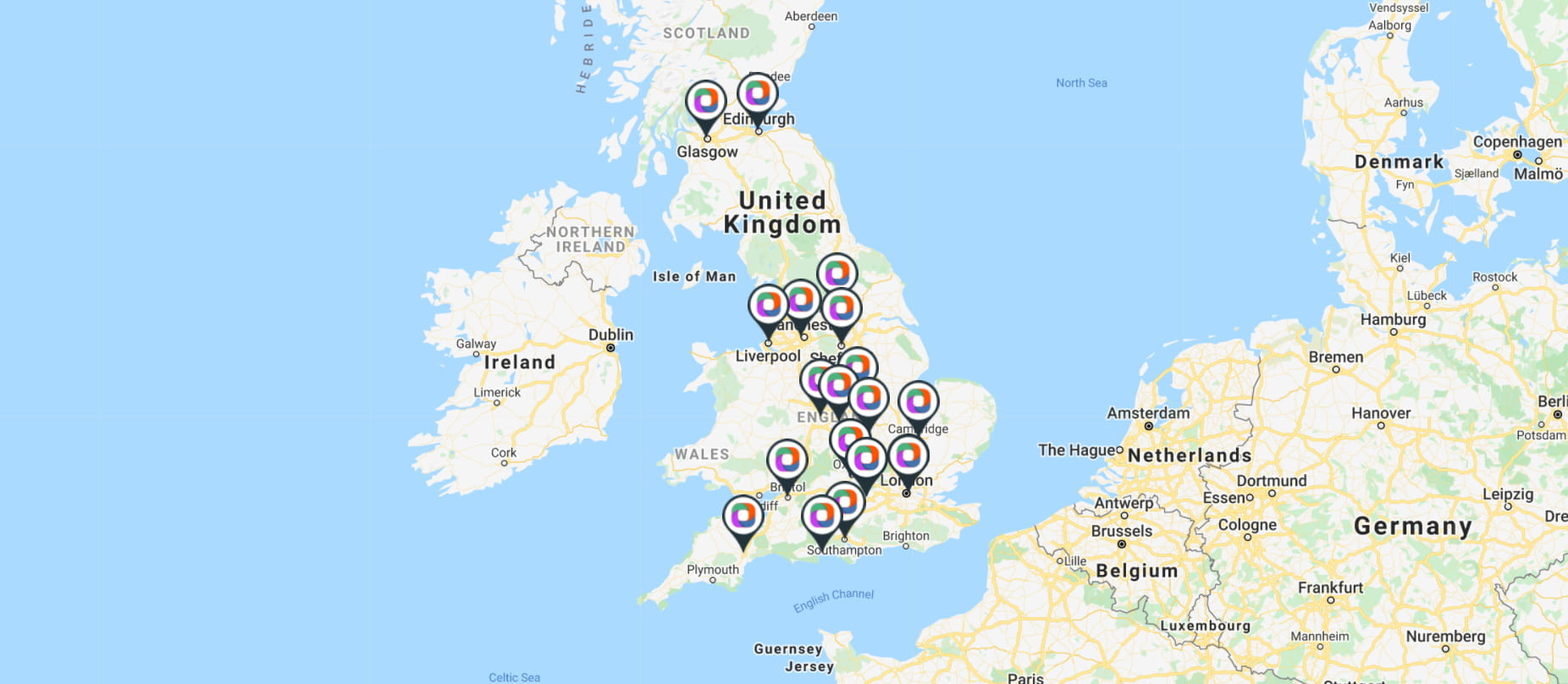
CERTIFIED TRANSLATION wherever you are in the UK
The service runs digitally end to end, so where you live makes no difference to the price or the timing. Send a scan, approve the quote, and the finished translation comes back by email – with the wet-stamped hard copy posted to your address when you need one.
Certified Government Translation Service Near You
Looking for a certified government translation service near you in London? Look no further, we've got you covered!
124 City Road, London, EC1V 2NX


