





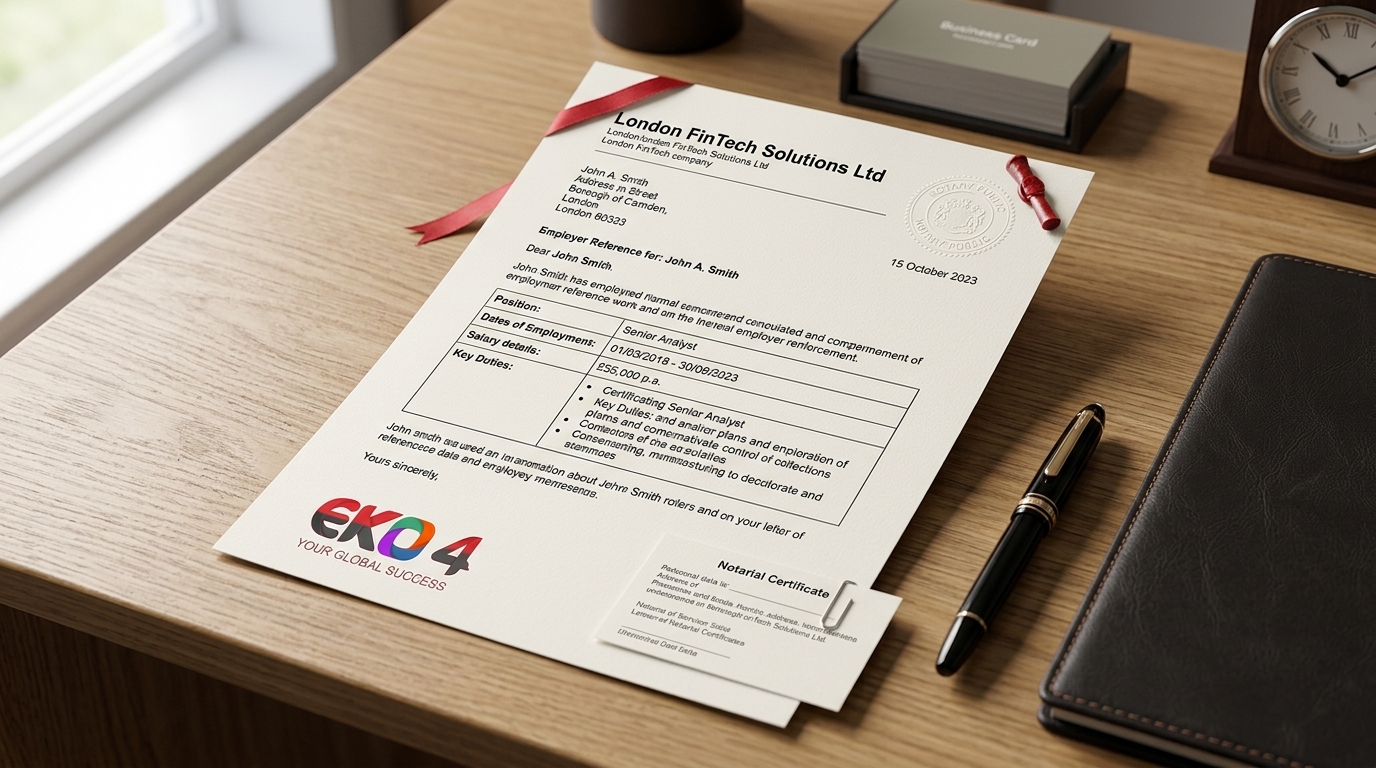
When relocating abroad, applying for an overseas work visa, or establishing a foreign business presence, verifying your professional history is of paramount importance. Obtaining a notarisation of employer reference letter is a standard step in this process, transforming a private corporate document into a legally recognised credential fit for international use.
Because an employer reference letter is drafted by a private commercial entity rather than a government body, foreign authorities cannot automatically verify its authenticity. Working with an experienced translation and legalisation specialist like EKO 4 Translations UK ensures that your professional documentation meets the exact standards expected by international bodies, immigration departments, and regulatory boards.
Why Do Foreign Authorities Require the Notarisation of an Employer Reference Letter?
An employer reference letter typically details your job title, salary, employment dates, and key responsibilities. However, because it carries no official government seal or signature, foreign immigration departments—such as Spain’s UGE or the UAE’s MoHRE—cannot accept it at face value. To bridge this gap, a UK notary public must step in to verify the document’s origins.
There are several common scenarios where you might need a notarised reference letter:
- Work Visas and Relocation: Proving your career history and professional experience to foreign immigration offices.
- Corporate Secondments: Facilitating international transfers within multinational corporations to overseas offices.
- Double Taxation Prevention: Demonstrating active UK employment alongside tax documents to avoid being taxed twice in different jurisdictions.
- Professional Registration: Presenting your credentials to overseas licensing bodies, such as foreign engineering councils or medical boards.
- Financial and Property Transactions: Setting up bank accounts or securing mortgages and rental agreements in another country.
For complex international moves, coordinating your paperwork early is vital. Our team frequently assists individuals and businesses with bespoke business and corporate translation services to ensure all corporate credentials are properly formatted and translated.
The Step-by-Step UK Notarisation Process
To secure a valid notarisation, the document must undergo a rigorous verification process. A notary public in England and Wales, regulated by the Faculty Office, cannot simply stamp any letter presented to them. They must follow a strict set of professional guidelines:
1. Professional Drafting
The reference letter must be printed on the official letterhead of your employer. It must be dated and signed by an authorised company representative, such as a human resources manager or director. It must contain complete and accurate details, avoiding generic or vague descriptions. Foreign authorities are increasingly demanding specific details, such as physical work locations and explicit remote-working terms, which must be clearly stated in the letter.
2. Authentication and Identity Checks
The notary public is legally required to verify the identity of the person presenting the document. More importantly, they must contact the issuing employer’s HR department directly to confirm that the signatory actually works for the company, had the authority to sign the letter, and that the contents of the reference are entirely genuine.
3. Issuing the Notarial Certificate
Once the notary is satisfied with the verification, they will attach a formal, wet-ink signed and sealed notarial certificate to the employer reference letter. Alternatively, if digital routes are preferred, a notary can apply a Qualified Electronic Signature (QES) to digital documents, facilitating modern electronic workflows.
Beyond Notarisation: FCDO Apostilles and Embassy Legalisation
While notarisation verifies the authenticity of the employer’s signature, foreign governments often require an additional layer of verification. This is where legalisation comes in. Because a reference letter is a private commercial document, the Foreign, Commonwealth & Development Office (FCDO) Legalisation Office will not apostille it directly; it must be notarised or certified by a registered solicitor first.
Depending on your destination country, different legalisation pathways apply:
- Hague Convention Countries: If you are moving to a nation that is a member of the Hague Apostille Convention, a UK apostille attached to the notarised document is sufficient. This can be a traditional paper apostille or a digital e-Apostille.
- Non-Hague Countries: For other global destinations, the document must undergo full consular legalisation (embassy attestation) at the respective embassy or consulate in London after the FCDO has issued the apostille.
Please note that whilst EKO 4 Translations UK is highly experienced in preparing legalised materials, we do not obtain apostilles on our clients’ original, native-English documents. If your original, untranslated reference letter requires an apostille, you must apply directly to the FCDO. However, we are fully equipped to handle the legalisation process for our translations.
How EKO 4 Translations UK Can Assist You
If your destination country’s official language is not English, a standard English reference letter will not suffice. You will need a professional translation to accompany your notarised original. At EKO 4, we provide high-quality translation solutions that meet the rigid standards of foreign authorities.
Depending on the requirements of the receiving body, we can offer:
- A highly accurate certified translation, featuring our signed statement of accuracy, unique stamp, and official company letterhead.
- A comprehensive notarised translation, solicitor-sworn declaration and FCDO apostille service, where our translator signs the declaration of accuracy in the presence of a notary public or solicitor, preparing the translation for use abroad.
- Specialised legal translation solutions for complex employment law documents, contracts, and court-bound reference materials.
To get started on your paperwork today, you can request an instant quote for our services or simply order your translation online through our secure portal.
Common Pitfalls and How to Avoid Them
Navigating the legalisation of private documents can be complicated, and simple errors can lead to delays or outright rejections by foreign ministries of labour. To keep your relocation or visa application on track, ensure you avoid these common mistakes:
- Scanned or Digital Image Signatures: The FCDO Legalisation Office and UK solicitors will reject any reference letter that features a generic scanned, copied, or pasted image signature (such as a JPEG of a signature). The document must feature a genuine wet-ink signature or a legally compliant digital signature.
- Delayed Employer Verification: Because a notary must verify the document’s authenticity with your previous or current employer, any delay from your employer’s HR department in responding to the notary will slow down the entire process. Alert your HR contact in advance to expect the notary’s verification email.
- Missing Vital Details: Generic “to whom it may concern” letters often lack the specific clauses demanded by foreign immigration authorities. Ensure the letter clearly lists your full name, exact job title, salary, dates of employment, and physical working location if you worked remotely.
By preparing your documentation carefully and partnering with EKO 4 Translations UK for your translation and legalisation needs, you can ensure a smooth, professional transition to your new global venture.


