





Close Copy Link Link copied successfully
GET A FREE
QUICK ESTIMATE
Please select one of the three options
Document # 1
Languages
Add Another Document +
Type of service
Sending, please wait
Your request has been sent successfully. A member of our team will get back to you shortly.
The file is too large, please note that the maximum allowed size per file is 15MB. Please try to shrink the file or call our office for assistance.

Apostille & Document
Legalisation in the UK


FCDO apostille arranged and tracked for you
Certified translation and solicitor certification in one place
Embassy legalisation for non-Hague countries
Free UK document delivery, no minimum spend
Type Source Language
Type Target Language
document-legalisation
Document legalisation, or Apostille legalisation service, is a special type of certification for official documents to be recognised by foreign countries. It has been signed as a treaty at the Hague Convention. There are numerous different varieties of documents to be legalised, depending on the issue and country.
EKO 4 apostille legalisation is an award-winning service for your documents. We provide fast & reliable service with international expertise since 1991. Working closely with solicitors, notaries public and the Foreign, Commonwealth & Development Office (FCDO), we are able to provide honest advice and a solution for your particular case.

Hague Convention

The Convention of Hague signed on 5th October 1961 abolished the requirement of apostille legalisation service for Foreign Public Documents. It has been named the Apostille Convention and is internationally recognised. It specifies the procedures through which a document issued in one of the signatory countries can be certified for official use in all the other signatory states. This certification is called an Apostille and this international process is comparable to a notarisation in domestic law, and normally supplements a local notarisation of the Apostille document also known as a “apostille legalisation service”.

apostille legalisation service

In the UK it is conducted by the FCDO to provide verification of the document confirming a UK Public Official’s signature in order to be recognised by official authorities or for legal purposes in other countries. As part of the apostille legalisation service process, the Apostille stamp is physically affixed to your document and embossed on it. EKO 4 Translations UK Ltd prepares and submits documents for legalisation on your behalf, so you never have to deal with the FCDO yourself.

Apostille legalisation service process

You may need apostille legalisation service in cases such as: working abroad, studying abroad, to register birth/marriage/death from UK abroad, expanding your business, for any legal purposes of case law, to validate international contracts, agreements, declarations, notary deeds etc.
There are two ways for legalising a document, either original or photocopy. Photocopies must be certified by a UK practicing solicitor or notary public. The only documents which cannot be legalised as a photocopy are birth/marriage/death certificates. We can help you to confirm with the overseas authorities if they require the originals or will accept copies.

International relations

Those countries which did not sign the Hague convention do NOT recognize the Apostille stamp as an official international stamp and may need a certification by the countries’ responsible consulate/embassy in UK. Some countries who signed the Hague convention would also need additional embassy certification after Apostille stamp prior to using the document overseas. Some of the countries would need additional certification of the translation or the credibility of the document. Embassies apply additional taxes for verification and certification. Most of the embassies are in London but have different accepting & processing times.

Hague convention

Document apostille legalisation service

Apostille legalisation service procedure

International relations

 CHOOSING OUR  apostille legalisation service   IS A HASSLE FREE DECISION 

Free consultation

/Read more/

We are always willing to help with our knowledge built on years of practice prior to becoming a client. We will keep you up-to-date every step of the way until you receive your documents.

Free document delivery

/Read more/

There is no minimum spending for free document delivery on document legalisation. Enjoy the experience of having your documents delivered to your door for free, anywhere in the UK.

Guarantees

/Read more/

We provide 1 month after-service guarantee for the documents we certified for overseas to be recognised and serve their purpose. Any problems that may occur or difficulties that you may experience we can support you with in the UK or overseas.

Quick turnaround

/Read more/

We process your documents through all stages as fast as possible. A specially designed workflow process allied to fast couriers and delivery service ensures that we will always be on time for you. Where a deadline is tight we will tell you at the quote stage which FCDO route your document qualifies for, and what that means for the date.

Money saving

/Read more/

Document legalisation can consist of several stages and may be costly. Find the EKOnomic way through EKO 4 document legalisations and bundle several services to save you money. If you have a large number of documents to be legalised, come to us – you are in the right place! Take advantage of our discounts that don’t discount quality! Additionally, we can provide a way of binding documents together to further reduce costs!

Security and confidentiality

/Read more/

The confidentiality of your personal and commercially sensitive data is secured by the strictest of policies within EKO 4 Document legalisation which ensure the highest level of professionalism. You may be assured that we fully guarantee the privacy & security of your documents during the legalisation process and beyond.


WHAT IS AN APOSTILLE and do you need one?

An apostille is a certificate from the Foreign, Commonwealth & Development Office confirming that a UK signature, stamp or seal on a document is genuine. It does not say anything about what the document means or whether the contents are true – only that the official who signed it really is who they say they are.

You need one when a UK document has to be used in another country. A foreign registrar, university or court has no way of knowing whether a British signature is real, so the apostille is the internationally agreed way of vouching for it. Inside the UK it is never required.

Only the FCDO can issue an apostille, and only over a signature it already recognises. That is the detail that decides your route: some documents arrive carrying such a signature and go straight to the FCDO, while others carry none and need a solicitor or notary to certify them first.

WHAT YOU GET with EKO 4 Translations

  • Accredited and sworn, fully bilingual philologist/linguist human translators
  • Additional native-speaking proofreader for quality assurance
  • Professional DTP (desktop publishing) editing and formatting
  • Signed affidavit and declaration of translation accuracy
  • Company wet stamp for authenticity
  • Official certification on company letterhead
  • Full compliance with ISO 17100 quality standard
  • Physical copy with wet stamps and company letterhead
  • No originals to post – a scan is all we need, and hard copies come to your address
  • Free corrections – any iterations, corrections or editing of the translations are free of charge and done same day or next day

WHICH ROUTE does your document take?

Our standard service apostilles the certified translation we produce, so most documents need nothing from this table – a scan is enough. It matters when the original has to be apostilled as well, or when you need an apostille with no translation at all: then the document has to carry a signature the FCDO already recognises, and these are the four ways it gets one.

  1. 01

    Straight to the FCDO

    The document already carries a signature or seal the FCDO holds on file, so nothing has to be added before it is submitted.

    • Birth, marriage, civil partnership, adoption and death certificates issued by the General Register Office
    • Court-sealed documents and court orders
    • Certificates of no impediment to marriage
    • ACRO police certificates
    • Documents signed by HM Revenue & Customs
    • Anything already signed by a UK solicitor, notary or Commissioner for Oaths
  2. 02

    Solicitor certification first

    The document carries no signature the FCDO recognises. A UK solicitor or notary certifies it, and the apostille is then issued over their signature. Sworn & notarised translation →

    • Degree certificates, transcripts and diploma supplements
    • GCSE, A-level, TEFL and CELTA certificates, school reports and letters of attendance
    • Certificates of incorporation, memorandum and articles, company records
    • DBS certificates
    • Passports, identity documents and driving licences
    • Proof of address, bank statements and employment letters
  3. 03

    Bound as a set

    Several documents bound together and apostilled as one, which is usually cheaper than legalising each one separately.

    • Company document packs
    • Academic records submitted together
    • Employment or immigration bundles
    • Professional registration sets
  4. 04

    Translation legalised too

    The translation itself is certified and legalised alongside the original – needed when the receiving authority wants the translated text to carry the same weight. Certified document translation →

    • Court documents, probates and judgments
    • Medical reports and criminal records
    • Powers of attorney and authorisation letters
    • Certificates of good standing and export certificates
    • Professional qualifications and membership certificates
    • Contracts, awards and company records

Not sure whether you need the translation certified, sworn before a solicitor or notarised as well? Certified translation covers UK use; sworn and notarised translation covers the witnessing step that some overseas authorities ask for.

Countries outside the Hague Convention need a further step: after the apostille the document goes to that country’s embassy in London for consular legalisation. Embassies set their own fees and processing times, so those are confirmed case by case.

PAPER OR ELECTRONIC apostille – which can you use?

The FCDO now issues apostilles two ways, and the difference matters far more than most providers admit: one is measured in days, the other in weeks.

Electronic (e-Apostille)

Up to 2 working days, and open to everyone. The document must be a PDF carrying the electronic signature of a UK notary or solicitor, which is exactly what a solicitor-certified document or a certified translation can be.

Paper (standard)

Up to 25 working days, plus postage. This is the route for original public records, and for anything that has to come back with a physical stamp embossed on it.

What the electronic route excludes

General Register Office certificates – birth, death, marriage, civil partnership and adoption – along with ACRO police certificates, DBS and disclosure certificates, fingerprint certificates and ACCA membership certificates. These are paper only.

Read that exclusion list again, because it is the single most useful thing on this page. If you need your original birth or marriage certificate apostilled, no one can give you the two-day electronic route – anybody promising it either has not read the rules or is quietly putting your document on the 25-working-day pile. But a certified translation of that certificate, signed by our solicitor, is not on the excluded list. Where the receiving authority will accept the legalised translation, the fast route is open. We will tell you which situation you are in before you commit to a date.

WHAT GETS APOSTILLED – your original, or the translation?

Almost always the translation, and that is the point: because the apostille goes on the document we produce, your original never has to leave your hands.

1

We translate and certify

A word-for-word translation on our letterhead, proofread by a second native speaker and issued with a signed, stamped certificate of translation accuracy.

2

A solicitor or notary certifies it

The declaration of accuracy is sworn before a UK solicitor or witnessed and sealed by a Notary Public – a signature the FCDO recognises. An apostille cannot be issued without this step, so it is always included.

3

The FCDO issues the apostille

Issued over that solicitor’s or notary’s signature, on the certified translation. You send a scan; we handle the forms, the fees and the submission.

Two things follow from apostilling our document rather than yours, and both are worth knowing. First, it stops mattering where your original was issued – another UK nation, or another country entirely – because the signature being authenticated is one obtained here. Second, it opens the fast route: General Register Office certificates are excluded from the FCDO’s 2-working-day electronic apostille, but a solicitor-signed translation is not.

When the original needs an apostille of its own

Some receiving authorities want the apostille on the UK public record itself, over the registrar’s signature, rather than on a translation of it – Spanish, Italian, Portuguese and Greek civil registries are the ones that ask most often, usually for citizenship by descent or for marriage. If yours is one of them, the original is apostilled first and the translation is then made of the document and the apostille certificate together, so nothing is missing from the set.

That is the one case where sequence matters, and it is settled by a single question: which country, and which body will receive it? Tell us those before anything is submitted and we will tell you which of the two you need. Already holding an apostilled original? Send it over – we translate the complete set, apostille certificate included.

0 +Years of Excellence
0 +Happy Customers
0 +Official Translators
0 Countries Approved EKO 4's Certified Translations

At EKO 4 Translations we guarantee 100%

  • Document Acceptance
  • Accuracy and Quality
  • Delivery on Time
  • Free Corrections

International document specialist with more than 35 years of combined experience

LEGALISATION PROCESS

Whichever country your document is going to, it takes one of the routes above – and we confirm which before anything is submitted

Did you get your documents legalised before travel overseas?

Get professional help! GET A FREE QUOTE TODAY

Our partners in providing success

WHICH COUNTRIES accept an apostille?

The 1961 Hague Convention abolished consular legalisation between its members: an apostille from the FCDO is enough, and no embassy step is needed. There are now 129 countries on that list, and it has grown quickly – China joined in 2024, along with Canada, and Saudi Arabia, Singapore, Indonesia, the Philippines, Pakistan and Bangladesh have all joined since 2021. Viet Nam joins on 11 September 2026.

If your destination is not listed, the document needs consular legalisation at that country’s embassy in the UK after the apostille. Some countries that are listed still ask for an embassy step or for the translation to be certified separately, so the list is the starting point of the answer rather than all of it.

  • Albania
  • Algeria
  • Andorra
  • Antigua and Barbuda
  • Argentina
  • Armenia
  • Australia
  • Austria
  • Azerbaijan
  • Bahamas
  • Bahrain
  • Bangladesh
  • Barbados
  • Belarus
  • Belgium
  • Belize
  • Bolivia
  • Bosnia and Herzegovina
  • Botswana
  • Brazil
  • Brunei Darussalam
  • Bulgaria
  • Burundi
  • Cabo Verde
  • Canada
  • Chile
  • China (incl. Hong Kong and Macao)
  • Colombia
  • Cook Islands
  • Costa Rica
  • Croatia
  • Cyprus
  • Czechia
  • Denmark
  • Dominica
  • Dominican Republic
  • Ecuador
  • El Salvador
  • Estonia
  • Eswatini
  • Fiji
  • Finland
  • France
  • Georgia
  • Germany
  • Greece
  • Grenada
  • Guatemala
  • Guyana
  • Honduras
  • Hungary
  • Iceland
  • India
  • Indonesia
  • Ireland
  • Israel
  • Italy
  • Jamaica
  • Japan
  • Kazakhstan
  • Kosovo
  • Kyrgyzstan
  • Latvia
  • Lesotho
  • Liberia
  • Liechtenstein
  • Lithuania
  • Luxembourg
  • Malawi
  • Malta
  • Marshall Islands
  • Mauritius
  • Mexico
  • Monaco
  • Mongolia
  • Montenegro
  • Morocco
  • Namibia
  • Netherlands
  • New Zealand
  • Nicaragua
  • Niue
  • North Macedonia
  • Norway
  • Oman
  • Pakistan
  • Palau
  • Panama
  • Paraguay
  • Peru
  • Philippines
  • Poland
  • Portugal
  • Republic of Korea
  • Moldova
  • Romania
  • Russian Federation
  • Rwanda
  • Saint Kitts and Nevis
  • Saint Lucia
  • Saint Vincent and the Grenadines
  • Samoa
  • San Marino
  • Sao Tome and Principe
  • Saudi Arabia
  • Senegal
  • Serbia
  • Seychelles
  • Singapore
  • Slovakia
  • Slovenia
  • South Africa
  • Spain
  • Suriname
  • Sweden
  • Switzerland
  • Tajikistan
  • Thailand
  • Tonga
  • Trinidad and Tobago
  • Tunisia
  • Türkiye
  • Ukraine
  • United Kingdom
  • United States of America
  • Uruguay
  • Uzbekistan
  • Vanuatu
  • Venezuela

Source: the HCCH status table for the 1961 Apostille Convention, checked August 2026. Membership changes – tell us the destination and we will confirm the current position for your document.

HOW LONG does an apostille take?

Three things set the date, and only the first one is ours: preparing the document, the witnessing step where one is needed, and the FCDO.

Our part

Document checks, certified translation where you need one and solicitor certification are normally turned round within 24 to 72 hours, with expedited service available on request.

The FCDO

The FCDO publishes up to 2 working days for its electronic service and up to 25 working days for the standard paper service, plus postage. Which one your document qualifies for depends on how it is signed.

The embassy, if needed

For countries outside the Hague Convention, add the embassy’s own processing time. Most are in London and each sets its own fees and timescales, which we confirm before you commit.

Occasionally the FCDO has to verify a signature against a central database, which can add up to 20 working days. It is rare, and we tell you the moment it happens rather than letting a deadline pass quietly.

APOSTILLE AND LEGALISATION questions, answered

What is an apostille?

An apostille is a certificate issued by the Foreign, Commonwealth & Development Office confirming that the signature, stamp or seal on a UK document is genuine. It is attached to the document itself and is recognised by every country in the Hague Convention. It says nothing about the contents of the document, only that the official who signed it is genuine.

Is an apostille the same as legalisation?

Legalisation is the name of the process; the apostille is the certificate attached at the end of it. For countries in the Hague Convention the apostille completes the process. For countries outside it, legalisation continues with a further step at that country's embassy in the UK.

Which countries accept an apostille?

The 129 countries in the Hague Convention, with Viet Nam joining on 11 September 2026. China joined in 2024, as did Canada, and Saudi Arabia, Singapore, Indonesia, the Philippines, Pakistan and Bangladesh have all joined since 2021 – older lists on other websites are often years out of date. If your destination is not a member, the document goes to that country's embassy after the apostille.

How do I get a UK birth or marriage certificate apostilled?

In most cases you do not need to: we translate the certificate, a solicitor or notary certifies the translation, and the apostille is issued on that – so a scan is enough and your certificate stays with you. Where the receiving authority insists on an apostille on the certificate itself, that has to be an original or a certified copy issued by the General Register Office, because the FCDO will not legalise a photocopy of one under any circumstances. Note too that GRO certificates are excluded from the electronic apostille service, so that route is paper only, while a solicitor-signed translation can take the 2-working-day electronic route.

Can I get an apostille on a photocopy?

Only if the photocopy has first been certified by a practising UK solicitor, notary or Commissioner for Oaths – the apostille is then issued over that person's signature. The exception is birth, marriage and death certificates, where a photocopy is never accepted whoever certifies it.

What exactly gets apostilled – my original document or the translation?

The translation, in almost every case. We prepare the certified translation, a UK solicitor or notary certifies it, and the FCDO issues the apostille over that signature. Your original never leaves your hands – a clear scan is all we need. Because the apostille goes on the document we produce, it also does not matter where your original was issued: another UK nation, or another country entirely.

When does the original itself need an apostille?

When the receiving authority wants the UK public record authenticated rather than a translation of it – Spanish, Italian, Portuguese and Greek civil registries ask for this most often, usually for citizenship by descent or marriage. In that case the original is apostilled first and the translation is then made of the document and the apostille certificate together, so nothing is missing from the set. Tell us the destination country and the receiving body and we will confirm which of the two you need before anything is submitted.

I already have an apostille on my document. Can you translate it?

Yes. We translate the complete set, apostille certificate included, so the receiving authority can read the stamp as well as the record. Send us a scan of everything you were given.

Can a translation be legalised?

Yes. The translation has to be certified, signed and dated by a practising UK public official – a solicitor or notary – and the apostille is issued over that signature. It also must not reproduce the crests or logos on the original document, which is a copyright matter and a frequent cause of rejection when translations are done cheaply.

What is an e-Apostille, and can I use it?

It is an electronic apostille issued on a PDF, published by the FCDO at up to 2 working days rather than up to 25. It is open to everyone, but the document must carry the electronic signature of a UK notary or solicitor, and several document types are excluded outright: General Register Office certificates, ACRO police certificates, DBS and disclosure certificates, fingerprint certificates and ACCA membership certificates. A solicitor-certified translation is not excluded.

Which documents need solicitor certification before the apostille?

Anything that does not already carry a signature the FCDO recognises – degree certificates, transcripts, school reports, company documents, passports and identity documents, driving licences, proof of address, employment letters and DBS certificates. Government-issued records such as GRO certificates, court-sealed documents and ACRO certificates go straight to the FCDO without it.

How long does the whole process take?

Our own part – checks, translation and solicitor certification – is usually 24 to 72 hours. The FCDO publishes up to 2 working days for the electronic service and up to 25 working days for standard paper, and an embassy step adds that embassy's own time on top. You get a confirmed end-to-end date with your quote rather than an optimistic guess.

How much does an apostille cost?

It depends on the route your document takes: whether it goes straight to the FCDO or needs solicitor certification first, whether it is legalised singly or as a bound set, whether a translation is involved, and whether the destination also requires embassy legalisation. Send us the document and the destination country and you will get an itemised quote, free and with no obligation, so you can see what each step adds.

My document is certified by a Commissioner for Oaths – is that enough?

Yes. A document signed by a Commissioner for Oaths carries a signature the FCDO recognises, so it can be legalised without further certification. Every practising solicitor in England and Wales is automatically a Commissioner for Oaths.

Could my document be delayed?

Occasionally. The FCDO sometimes has to verify a public official's signature against a central database, which can take up to 20 working days. It is rare, and we let you know as soon as we are told rather than waiting for you to chase.

I need my degree and transcripts legalised for a job abroad. What do I do?

Send us the documents and the destination country. Educational documents carry no FCDO-recognised signature, so they need solicitor certification first – and we recommend certifying copies rather than the originals, so your degree certificate does not come back covered in stamps. Several documents bound and legalised as one set is usually cheaper than doing them individually.

I am getting married abroad. What do I need?

Most commonly a certificate of no impediment, your birth certificate, and where you have been married before a decree absolute – each apostilled, and usually translated into the language of the country you are marrying in. Requirements vary a great deal between countries and some registrars are strict about how recently the documents were issued, so check with the authority conducting the marriage and send us the list. Start early: this is the deadline people most often leave too late.

Do I have to deal with the FCDO myself?

No. We prepare the paperwork, arrange any solicitor or notary certification, submit the documents and track them through, and return the legalised set to you by post or for collection at one of our UK offices. You do not need an FCDO account.

This page explains general UK practice so you can order the right thing. It is not legal advice, and the authority receiving your document always has the final say on what it will accept – which is why we ask which country and which body before we quote. FCDO fees and service times are as published by the FCDO and can change.

Tell us the document and the destination

Send a scan, name the country and the authority that will receive it, and you will get back the route your document takes, an itemised price and a delivery date. The quote is free, there is no obligation, and UK document delivery is included.

APOSTILLE SERVICE anywhere in the UK

Legalisation normally means originals travelling – to a solicitor, to the FCDO, sometimes to an embassy – and that is exactly what people dread about it. Because the apostille goes on the certified translation we produce rather than on your document, none of that travelling is yours: a scan is all we need and your originals stay where they are.

The finished, apostilled set is delivered to your address, tracked at every stage, and document delivery within the UK is free with no minimum spend. Wherever you are in the country, the service is the same.

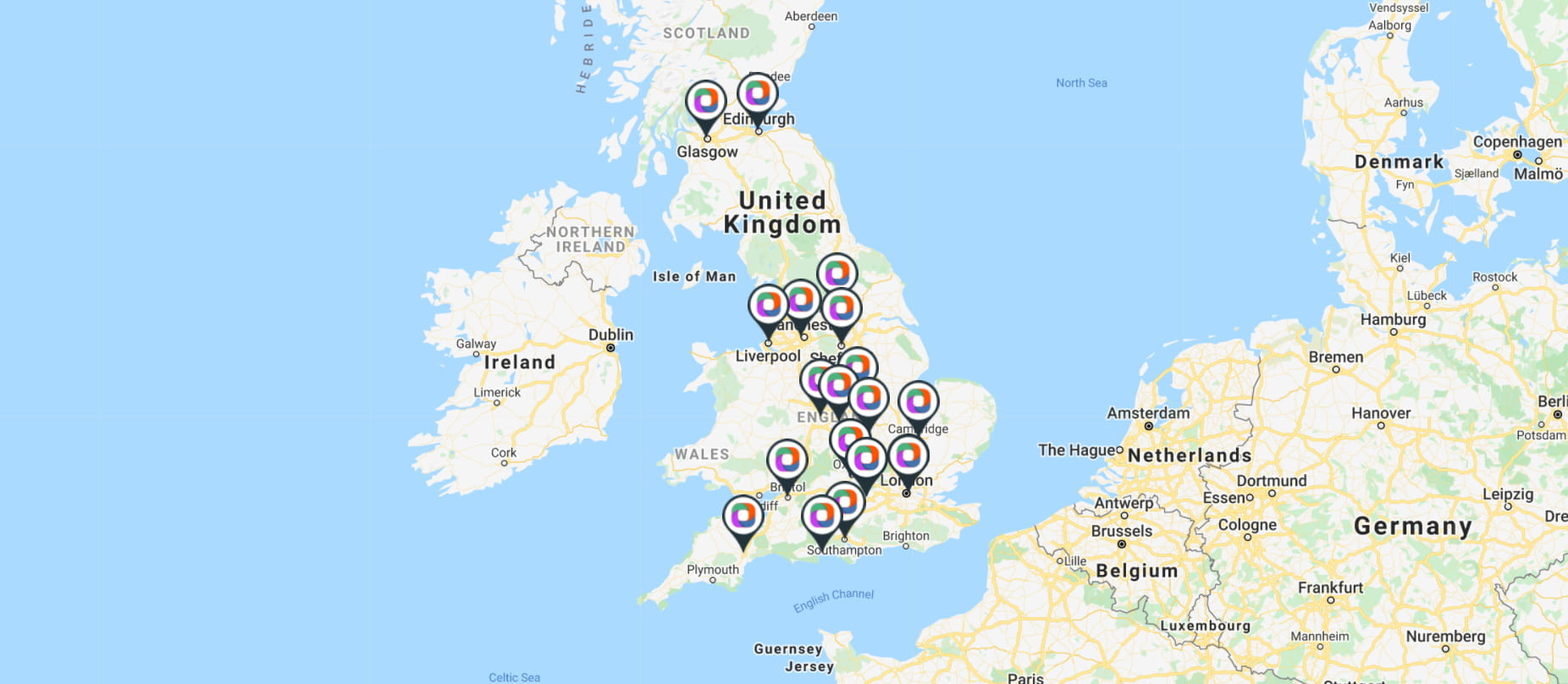
Certified Government Translation Service Near You
See all locations
Looking for a certified government translation service near you in London? Look no further, we've got you covered!
124 City Road, London, EC1V 2NX
Please select one of our locations for contact details
Belfast
Castlereagh St, Belfast
Birmingham
St Paul's Square, Birmingham
Birmingham
Birmingham, Tyseley
Bournemouth
Lorne Park Rd, Bournemouth
Cambridge
Cambridge - Orwell Furlong
Cardiff
5, Capital Tower, Greyfriars Rd, Cardiff
Chesterfield
Chesterfield - Chatsworth
Coventry
Walgrave Rd, Coventry
Dunfermline
Dunfermline
Edinburgh
Hill St, Edinburgh
Edinburgh
Glasgow
Newton Pl, Glasgow
Glasgow - East Kilbride
Hudderfield
Hudderfield
Ipswich
Ipswich
London
Bishopsgate, London
City Road, London
London - Epsom
London - Camden
London - Uxbridge
Lutterworth
Lutterworth
Manchester
MediaCityUK, Manchester
Manchester
Manchester, Altrincham
Milton Keynes
Milton Keynes - Bradwell Abbey
Newport
Newport
Northampton
Moulton Park, Northampton
Nottingham
Nottingham - Mapperley
Oxford
Oxford
Paisley
Paisley
Poole
Poole
Portsmouth
Victory Business Centre, Portsmouth
Preston
Preston
Reading
Reading - Basingstoke
Redditch
Redditch - Prospect Hill
Sheffield
Sheffield
Swansea
Morriston, Swansea