




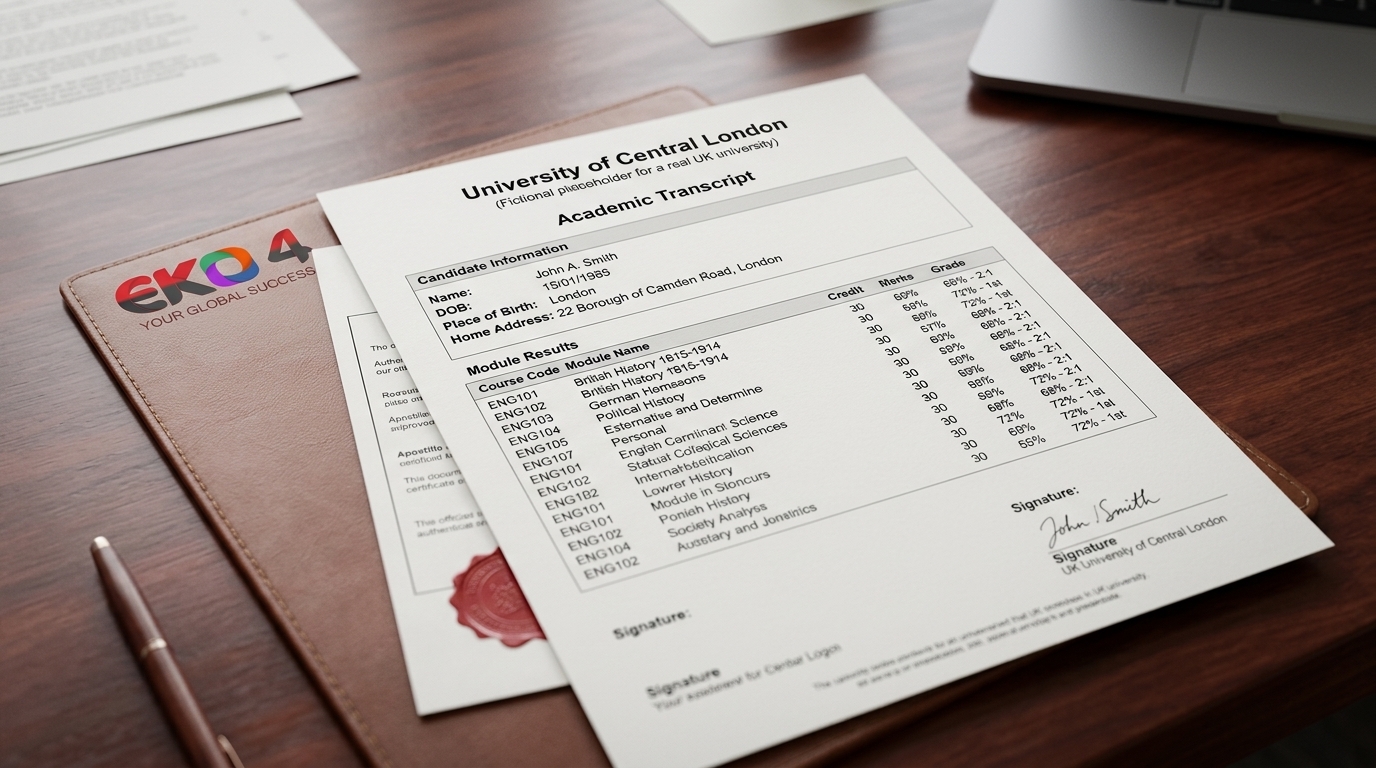
When applying to study, work, or register with professional regulatory bodies outside the UK, foreign authorities frequently require detailed verification of your academic background. While a degree certificate confirms your final qualification, an academic transcript breaks down the specific modules, credit values, and individual grades achieved throughout your programme of study. To ensure this document is recognised as valid in another country under the Hague Apostille Convention, you will usually require an apostille of academic transcript. At EKO 4 Translations UK, we regularly assist clients navigating this process by providing certified academic transcript translation alongside clear guidance on legalisation requirements.
What is an apostille of academic transcript and when do you need one?
An apostille is an official certificate issued by the Foreign, Commonwealth & Development Office (FCDO) that authenticates the signature, seal, or stamp on a UK public or legalised document. An apostille of academic transcript proves to overseas authorities that your educational record originates from a genuine UK institution and has been properly authenticated by a UK solicitor or notary public.
Foreign institutions and government bodies demand legalised academic transcripts for several key reasons:
- Higher Education & Admissions Abroad: Overseas universities require module-by-module breakdowns for undergraduate or postgraduate admissions, PhD candidacies, and credit transfer evaluations.
- Credential Evaluation Services: Organisations such as World Education Services (WES) in North America or European Credit Transfer and Accumulation System (ECTS) assessment bodies require authenticated transcripts to perform official equivalency evaluations.
- Professional Registration & Licensing: Foreign regulatory boards in healthcare, engineering, teaching, law, and accountancy need to verify your detailed curriculum before granting a professional licence to practise.
- Employment & Work Visas: Immigration departments and employers in foreign countries—particularly across East Asia (such as Japan, South Korea, and Vietnam) and the Middle East—require legalised transcripts to issue specialist work permits.
The UK legalisation process for academic transcripts
Unlike public records issued directly by central government registries (such as GRO birth or marriage certificates), academic transcripts are issued by individual UK universities, colleges, or awarding bodies. Because the FCDO Legalisation Office does not keep signature records for every university registrar across the country, academic transcripts almost always require an intermediate verification step before an apostille can be attached.
1. Solicitor or Notary Verification
Before submitting an academic transcript to the FCDO, a UK-registered practicing solicitor or notary public must verify its authenticity. FCDO rules require solicitors to verify unsealed paper transcripts or digital PDFs directly with the issuing university’s student registry or via secure verification services such as Higher Education Degree Datachecks (HEDD). Once verified, the solicitor adds a statement of certification, their wet-ink signature (or an Advanced Electronic Signature for digital records), their stamp, and their SRA or notary practicing number.
2. FCDO Legalisation (Paper and e-Apostille)
Once certified by a solicitor or notary, the document is submitted to the FCDO Legalisation Office. The FCDO checks the solicitor’s signature against its official database and attaches the apostille:
- Paper Apostille: A physical certificate permanently attached to the solicitor-certified paper transcript.
- e-Apostille: An electronic apostille issued as a digitally signed PDF, suitable when the transcript and solicitor certification are handled completely in digital format with an approved cryptographic signature (AES or QES).
For destination countries that are not members of the Hague Apostille Convention, the transcript must undergo a further legalisation step at the destination country’s embassy or consulate in London following the FCDO apostille.
Translating your academic transcript for overseas use
When submitting a UK academic transcript to an authority in a non-English-speaking country, you will almost certainly need a formal translation alongside your legalised UK document. It is important to understand the distinct roles involved in legalising the transcript itself versus legalising its translation:
- Your Original Document: Obtaining the FCDO apostille on your original academic transcript or solicitor-certified copy is an application you make directly to the FCDO Legalisation Office (or through a legalisation agent).
- Your Translated Document: When a foreign body requests an apostilled translation, EKO 4 Translations UK handles the complete linguistic and legal procedure. We produce a certified translation of your transcript into the destination language. Our translator’s declaration of accuracy is then formally sworn before a UK solicitor or notarised by a notary public. The FCDO subsequently places an apostille on that solicitor’s or notary’s signature.
Certain countries request a “sworn translation” (such as a traductor jurado in Spain or a tłumacz przysięgły in Poland). Because the UK legal system does not register sworn translators in the continental manner, UK translations achieve equivalent legal standing for overseas authorities through the legalised route: a professional certified translation sworn before a UK solicitor or notarised, followed by an FCDO apostille. To arrange this service, visit our dedicated page for notarised translation and apostille services.
Common mistakes to avoid with transcript legalisation
Errors during document preparation can cause significant delays or rejections by foreign bodies. Keep these critical points in mind:
- Bypassing Solicitor Verification: Sending an uncertified academic transcript directly to the FCDO will result in immediate rejection, as university signatures are rarely registered directly on the FCDO database.
- Bundling Documents Under One Cover: Combining a degree certificate and a multi-page academic transcript under a single solicitor cover page to reduce costs is generally rejected by foreign embassies and credential evaluators like WES. Overseas recipient bodies usually enforce strict per-document rules, requiring separate apostilles for each distinct qualification document.
- Printing Digital PDFs onto Paper: Printing out a digitally signed electronic transcript invalidates its cryptographic signature. If you need a physical paper apostille, the transcript copy must be formally verified and wet-ink certified by a solicitor as a true paper copy.
- Using Portal Screenshots or Unofficial Printouts: Unverified printouts from student web portals are not accepted for legalisation. You must present an official transcript issued by your university registry or ensure your digital PDF undergoes proper solicitor verification.
Whether you are enrolling in a university abroad, obtaining a professional licence, or relocating for work, ensuring your academic documents are accurately translated and legalised is vital. To start your translation process today, request a free quote or easily order your translation online with EKO 4 Translations UK.


