




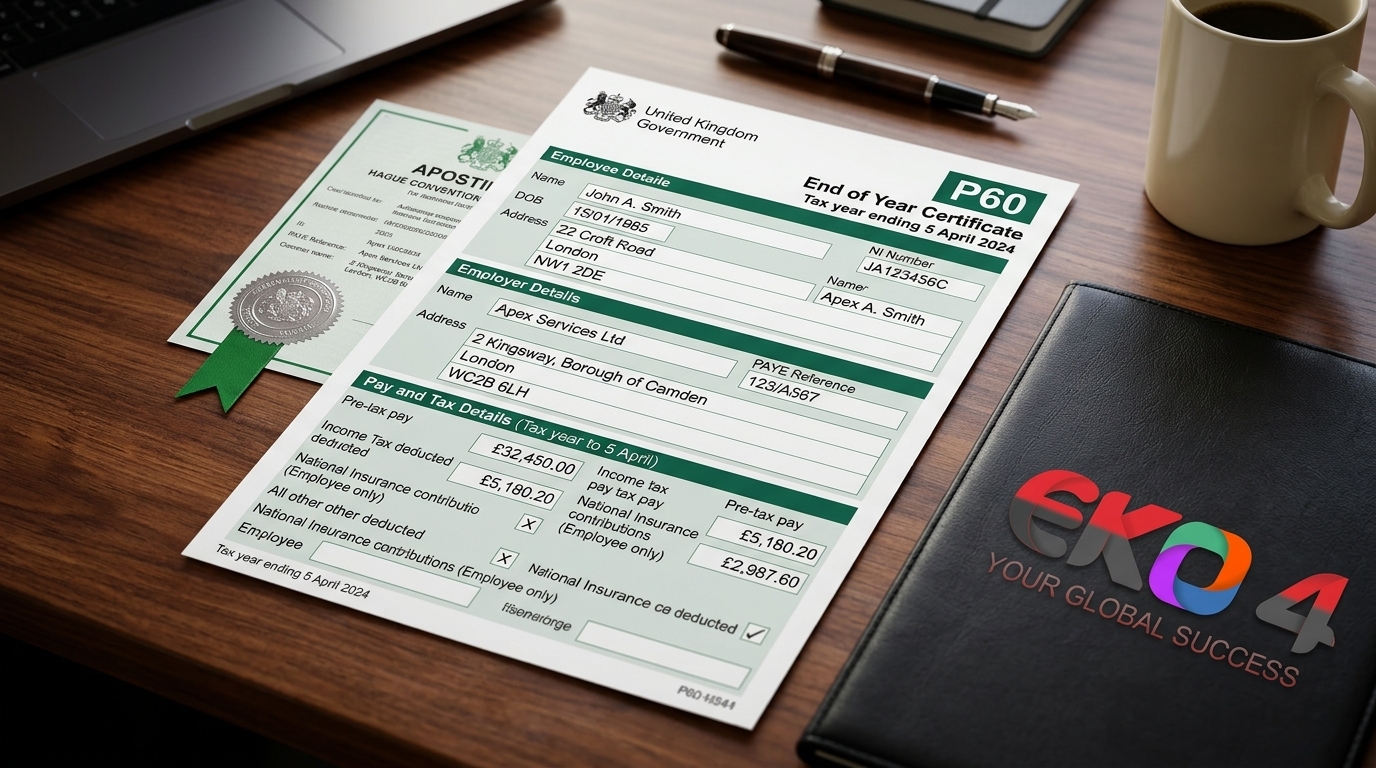
When moving overseas, buying property in southern Europe, or applying for foreign residency, individuals must often prove their historic UK earnings and tax contributions. An apostille of P60 end-of-year certificate provides the formal legal verification required by foreign public bodies under the Hague Apostille Convention. A P60 is issued directly by an employer or a payroll bureau instead of by a civil servant at HM Revenue and Customs (HMRC). Because the document lacks the signature or seal of a recognised public official, it cannot go straight to the Foreign, Commonwealth & Development Office (FCDO) Legalisation Office without preparatory legal certification.
Why foreign authorities request an apostille of P60
The P60 summarizes the total taxable pay received and statutory deductions made under the Pay As You Earn (PAYE) system during a particular UK tax year. Foreign administrative bodies, courts, and financial institutions regard an apostilled P60 as formal evidence of earned income, employment history, and tax residency.
Immigration authorities across European Union member states regularly rquest apostilled P60 certificates. Consulates for Spain, Portugal, Greece, and Italy need them to assess financial self-sufficiency for non-lucrative visas, retirement permits, and digital nomad visas. In these instances, foreign immigration departments assess earnings from previous tax periods to verify that applicants have reliable financial resources without looking for local employment.
Foreign tax administrations, such as the Spanish Agencia Tributaria or the Greek Independent Authority for Public Revenue, inspect apostilled P60s to establish previous fiscal domicile and confirm that income tax was deducetd at source in the UK, satisfying double taxation treaty rules. Overseas lenders and notaries handling international conveyancing also ask for these certificates when conducting financial underwriting for cross-border mortgage applications. Outside the European Union, ministries and labour departments in Middle Eastern jurisdictions, including the United Arab Emirates, Qatar, and Saudi Arabia, need an apostilled P60 as part of the visa sponsorship and professional licensing clearance procedure.
The solicitor certification and FCDO legalisation process
The FCDO Legalisation Office checks the authenticity of signatures, stamps, and seals on UK public documents. Because an employer or payroll deartment produces a P60, the FCDO does not maintain records of the individual who generated or signed it. Consequently, the original printout, downloaded PDF, or photocopy must first be certified by a practising UK solicitor or Notary Public whose signature is registered with the FCDO.
The certifying lawyer inspects the P60 and endorses it with an official declaration, signature, and professional stamp. Under current Solicitors Regulation Authority and FCDO anti-fraud guidance, the certifying professional must explicitly state the nature of their inspection: whether they examined an original hard-copy document issued by the employer or certified the document as a true copy of an electronic download.
Once certified, the document is sent to the FCDO Legalisation Office for the apostille. The client sends their certified document directly to the FCDO. The FCDO verifies the lawyer’s signature against its database and attacches the apostille certificate to the paper. While the FCDO provides an electronic e-Apostille service for certain digitally signed files, foreign authorities, overseas land registries, and foreign consulates often reject digital formats in favour of a physical apostille permanently affixed to a hard-copy legal certificate.
For countries that are not signatories to the Hague Apostille Convention, the procedure requires an additional step known as embassy legalisation. After the FCDO attaches the apostille, the document must be presented to the London embassy or consulate of the destination country for fianl consular attestation before it is legally valid in that state.
Translating the legalised P60 for use abroad
When presenting a P60 in a country where English is not an administrative language, receiving authorities require an accurate translation together with the legalised English certificate. Foreign civil registries, courts, and tax departments seldom review documents in English without a local-language translation.
The client obtains the apostille on their original P60 from the FCDO before submitting it for translation. Once the original document carries its apostille, EKO 4 Translations UK produces the translation of both the P60 and the affixed apostille certificate. Because payroll forms feature technical fiscal codes, statutory allowances, and National Insurance categories, specialist financial translation ensures that foreign tax assessors understand every line item.
When a destination authority requires a legalised translation (often refrered to in civil-law jurisdictions as a sworn translation), EKO 4 Translations UK arranges for the translator’s declaration of accuracy to be formally sworn before a UK solicitor or notarised by a Notary Public. The FCDO can then legalise the solicitor’s signature on that declaration, creating an apostille on the translation itself. Clients can arrange this by choosing our service for notarised translation and solicitor-sworn declarations. To strat the translation process, you can request a free quote or proceed directly to order your translation online.
Frequent submission errors with PAYE tax certificates
Applicants face delays when basic administrative rules are overlooked during the legalisation sequence.
- Sending the P60 directly to the FCDO: Submitting an employer-issued P60 without prior certification by an FCDO-registered solicitor or Notary Public leads to direct rejection by the Legalisation Office.
- Selecting the wrong legal professional: While solicitor certification satisfies FCDO requirements for most European states, specific jurisdictions in the Middle East and Latin America demand that legalisation originate from a Notary Public rather than a solicitor.
- Assuming an electronic apostille is accepted everywhere: Many civil law notaries and foreign public offices insist on physical apostilles tied to paper documents, rejecting electronic PDF apostilles.
- Omitting complementary tax documents: A P60 covers only the employment income received from one specific employer during that tax year. If an applicant has multiple revenue sources, foreign immigration and tax bodies will request an HMRC SA302 calculation or an official HMRC Certificate of Residence in addition to the P60.
- Translating the P60 before obtaining the apostille: If a translation is finnished before the original P60 receives its apostille from the FCDO, the translation will not include the text of the apostille certificate itself. Foreign authorities often reject translations that do not account for the legalisation stamp attached to the main document.


