




Pursuing higher education or employment overseas is an exciting venture that opens doors to incredible global opportunities. For many students and professionals educated in the United Kingdom, their Advanced Level (A-level) certificates are the golden keys to these pathways. However, when presenting these credentials to foreign universities, employers, or immigration authorities, you will almost certainly require a professional translation of A-level certificate documents to ensure your achievements are fully understood and recognised abroad. Conversely, those coming to the UK with equivalent school-leaving qualifications from overseas will need a certified translation into English to satisfy British institutions and government bodies.
At EKO 4 Translations UK, we specialise in delivering precise, certified, and officially recognised translations of academic documents. Whether you are aiming to study in Europe, secure a work visa in the Middle East, or enrol in a university course in the UK, understanding the translation and legalisation process is crucial to avoiding administrative delays.
Why Do You Need a Translation of A-level certificate?
Academic credentials do not always travel easily across borders without official validation. While A-levels are highly respected globally, foreign admissions offices and employers require translations to accurately map your grades and subjects to their local educational frameworks. The certified translation of academic documents is primarily requested for several key scenarios:
- Undergraduate Study Abroad: An increasing number of UK school leavers are choosing to study at European universities—particularly in Germany, Spain, and the Netherlands—to access diverse programmes or manage tuition costs. To matriculate, these universities require official translations of your academic records. For this, utilising a specialised academic translation service ensures your grades are translated with the utmost precision.
- Employment and Work Visas: If you are applying for a skilled-worker visa or a professional role in another country, immigration authorities and corporate HR departments often demand verified proof of your secondary education.
- Residency and Settlement: Certain nations assess educational backgrounds as part of points-based immigration systems, requiring officially certified translations of all educational qualifications.
For those entering the UK, the process works in reverse. If you hold equivalent European or international school-leaving certificates, you must present a certified translation to UK bodies such as the Home Office, UK Visas and Immigration (UKVI), and various educational institutions. We regularly work alongside academic bodies to facilitate this through our dedicated translation services for universities, helping international students transition smoothly into British higher education.
The Legalisation and Translation Process Explained
Because A-level certificates are issued by independent examining boards (such as AQA, OCR, or Pearson Edexcel) rather than direct government departments, they cannot be legalised by the Foreign, Commonwealth & Development Office (FCDO) without prior certification. If you need to use your UK A-level certificate abroad, the standard legalisation and translation procedure involves several precise steps.
1. Solicitor or Notary Certification
Before any government legalisation can occur, a UK solicitor or Notary Public registered with the FCDO must certify the original certificate or a photocopy as a true and genuine document.
2. FCDO Legalisation (Apostille)
Once certified by a solicitor, the document must be submitted to the FCDO Legalisation Office to receive an Apostille. This can be issued as a traditional physical Paper Apostille or, for eligible destinations, an e-Apostille. Please note that the owner of the document must apply directly to the FCDO to obtain an apostille on their original certificate.
3. Certified Translation
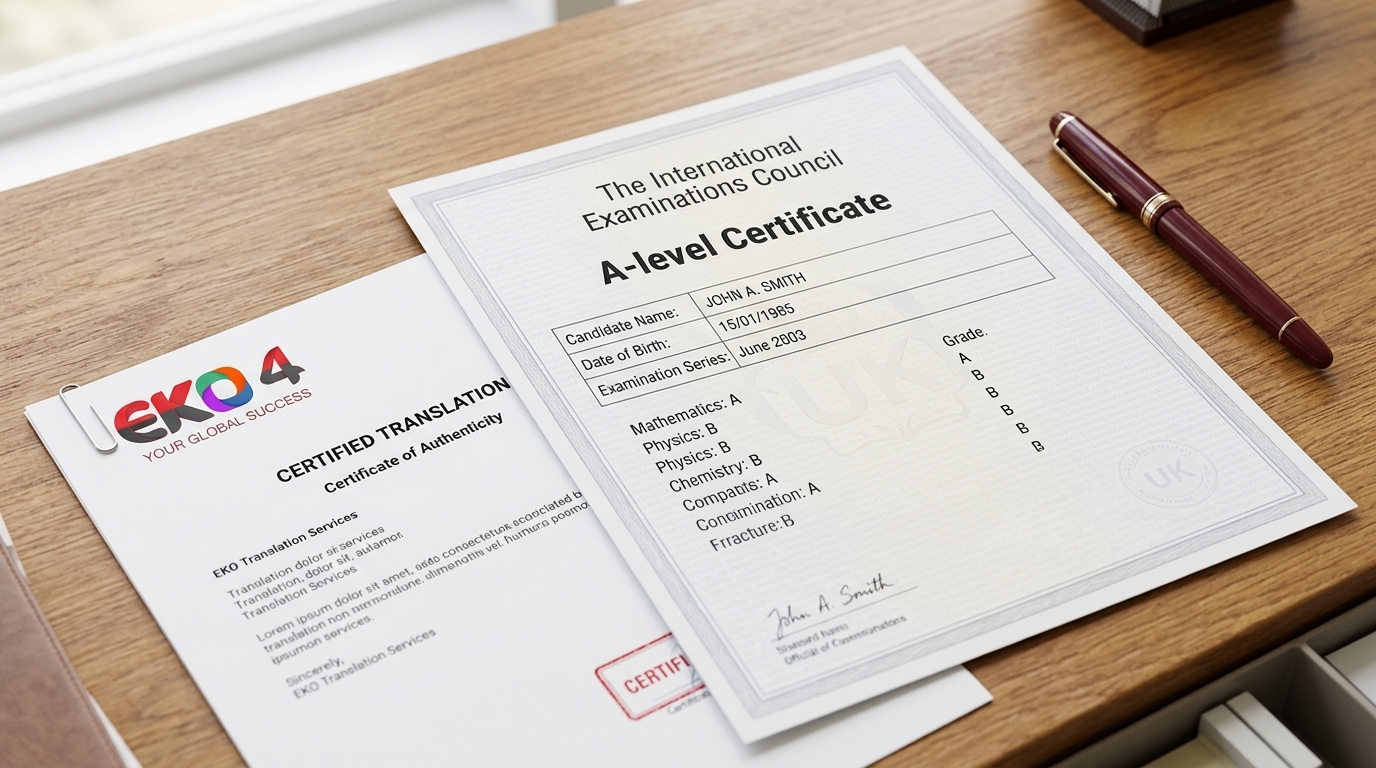
Once the document has been legalised, the translation must be performed. If the receiving country requires the Apostille itself to be translated, the translation must take place after the FCDO has attached the Apostille to the certified certificate. In the UK, a professional certified translation service must include a formal Certificate of Translation Accuracy on the translation company’s letterhead. This certificate must detail the translator’s credentials, full name, signature, contact details, and the date.
For situations where the foreign authority requires an extra layer of official validation, EKO 4 Translations UK offers a comprehensive notarised translation, solicitor-sworn declaration and FCDO apostille service. In this scenario, we have our translator’s declaration of accuracy sworn before a solicitor or notary, and we then obtain the FCDO apostille on that specific sworn translation to ensure it meets the strict criteria of overseas legal bodies.
Navigating Country-Specific Academic Translation Requirements
Different countries have distinct rules regarding academic translations, and failing to research these in advance can lead to rejected applications. Recent joint updates from major UK linguistic bodies, including the Institute of Translation and Interpreting (ITI) and the Chartered Institute of Linguists (CIOL), emphasise the importance of standardising certification practices to prevent international rejection.
Spain
Spanish universities and the Ministry of Education are major recipients of translated UK A-level certificates, and Spanish authorities ask for a sworn translation (traducción jurada). For documents going to Spain, we provide the legalised route: our translation, sworn before a solicitor or notarised, with the FCDO apostille on that signature.
The Middle East
The United Arab Emirates (UAE) enforces a multi-layered attestation process. Typically, a UK A-level certificate must first be legalised with a UK FCDO apostille, followed by attestation at the UAE Embassy in London, and finally a certified translation into Arabic.
The United States
While US universities and academic evaluation services (such as WES) do not always demand an Apostille for standard undergraduate admissions, they do strictly require official, certified English translations of any foreign school-leaving equivalents. Accurate terminology mapping is vital here to ensure your high school equivalent grades are evaluated correctly.
Common Mistakes to Avoid When Translating Your A-levels
To ensure your academic translation process is as seamless as possible, steer clear of these frequent pitfalls:
- Translating Before the Apostille is Issued: If you translate your certificate first and then get it apostilled, the Apostille stamp itself remains untranslated. Many foreign ministries will reject documents where any official text or stamp is not translated into their official language. Always apostille first, then translate.
- Submitting Directly to the FCDO: Sending an exam-board issued A-level certificate directly to the FCDO without prior solicitor or notary certification will result in immediate rejection, costing you valuable time in your university application window.
- Self-Translation: No matter how fluent you are in the target language, you cannot translate your own academic documents. Foreign ministries, employers, and universities require an independent, accredited professional translation carrying official credentials, stamps, and signatures from recognised bodies like the CIOL or ITI.
Get Your Professional Academic Translation with EKO 4 Translations UK
When your academic or professional future is on the line, relying on amateur translation is a risk not worth taking. EKO 4 Translations UK provides high-quality, certified translations that comply with the exact standards demanded by educational boards, government ministries, and employers worldwide.
We carefully manage every step of the linguistic process, matching your academic certificates with experienced translators who understand school-leaving terminologies, grades, and equivalent certifications in 76 different languages. If you are preparing to submit your academic credentials abroad or need foreign qualification documents translated for use in the UK, you can easily request a free quote from our expert team or simply order your translation online today. Let EKO 4 help you transition smoothly to your next international academic or professional chapter.


