




Today, 15 November 2026, Orthodox and Eastern Catholic Christians start a period of spiritual preparation known as the Beginning of the Nativity Fast (Orthodox Christmas Fast). Many people call this time St. Philip’s Fast, because it begins straight after the feast day of the Apostle Philip on 14 November. Across Greek, Greek Cypriot, Romanian, Ukrainian and Bulgarian homes, family members greet one another with customary seasonal blessings. Greek speakers say “Καλό Σαρακοστιανό!”, Romanians say “Post binecuvântat!”, and Ukrainians say “Благословенного посту!”. These greetings convey wishes for a blessed fast over the next forty days.
The forty days of fasting
The Nativity Fast covers forty days, running from 15 November through 24 December. It has an established history in Byzantine liturgical tradition, and it was formalisd at the Council of Constantinople in 1166. Eastern Orthodox and Eastern Catholic churches that follow the Revised Julian calendar observe this time. These include the Orthodox Church of Greece, the Church of Cyprus, the Romanian Orthodox Church, the Bulgarian Orthodox Church, and the Orthodox Church of Ukraine, which officially adopted the Revised Julian calendar in September 2023, together with the Ukrainian Greek Catholic Church.
The fast carries an atmosphere of joyful expectation. Liturgical teaching guides believers toward personal reflection, almsgiving, repentance and self-restraint. The dietary rules require abstaining from meat, poultry, dairy products and eggs for the whole forty days.
The fast is split into two separate periods. The first period starts on 15 November and lasts until around 19 or 20 December. During these early weeks, the dietary rules are less strict. Believers are permitted to consume fish, olive oil and wine on Saturdays and Sundays, as well as on specified feast days. Two major feast days fall during this early stage: the Entry of the Theotokos into the Temple on 21 November and St. Andrew’s Day on 30 November.
The discipline changes during the last week before Christmas. From arround 20 December through Christmas Eve on 24 December, fish is strictly forbidden. The everyday meals become simpler. This time leads straight up to the Nativity of Christ on 25 December.
Fasting dishes across Eastern Europe
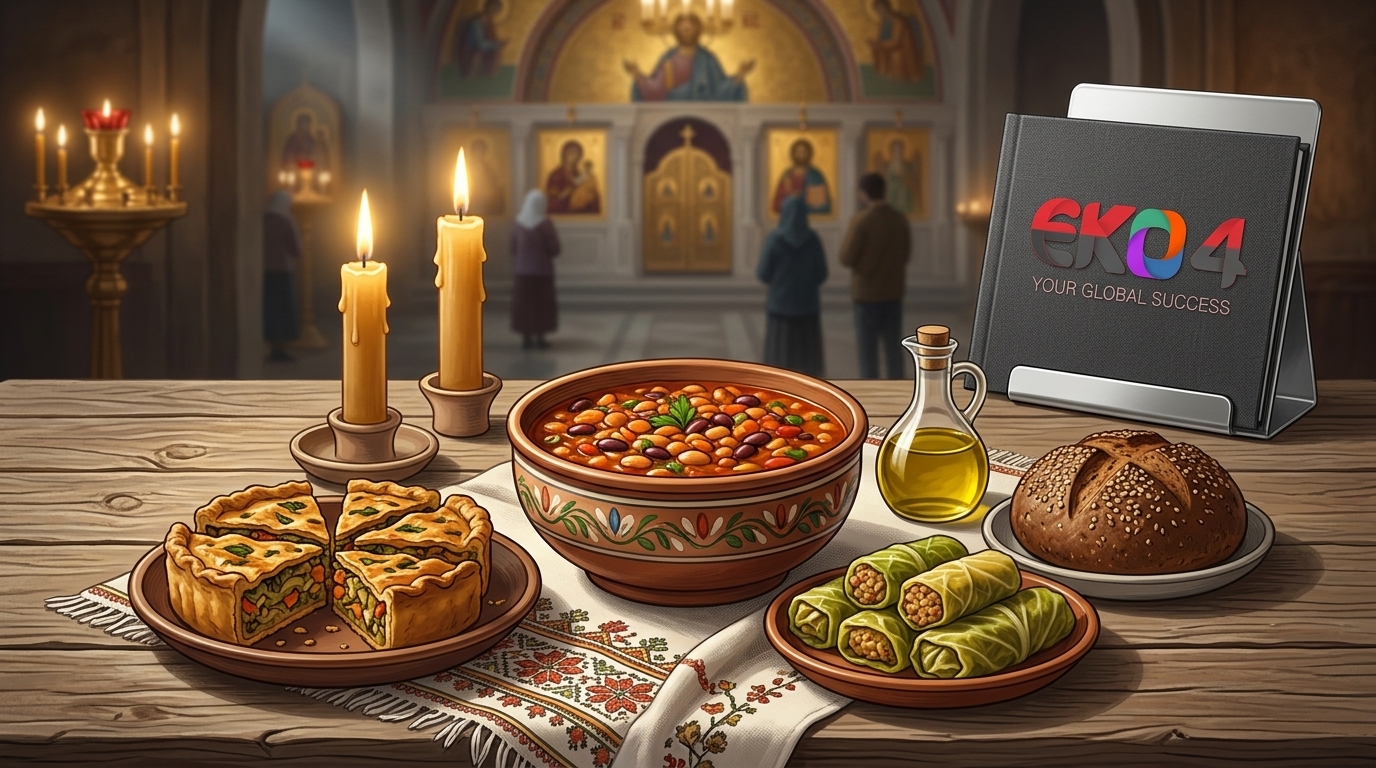
Homeland traditions reflect the dietary rules through different national recipes. In Romania, families make vegan dishes known as mâncare de post. Family tables feature bean stews, cabbage rolls stuffed without meat (saramle de post), polenta (mămăligă) and vegetable pies. These meals provide sustenance while following the church calendar.
In Ukraine, the fasting period is known as Pylypivka. Families observe this period through domestic preparations that lead up to the traditional Christmas Eve Holy Supper, known as Sviatyi Vechir. Daily meals throughout Pylypivka depend on winter supplies of root vegetables, grains and preserved legumes.
In Greece and Cyprus, faithful refer to the season as Sarakosti tou Christou. Believers attend special liturgical srvices and change their daily menus. Family meals consist of lentils, beans, wild greens and bread. On designated Saturdays and Sundays when fish is permitted, families make simple seafood dishes accompanied by olive oil.
Parish life in British cities
Across the United Kingdom, diaspora communities keep these customs within their parishes. Believers belogning to the Greek Orthodox Archdiocese of Thyateira and Great Britain, the Romanian Orthodox Metropolis of Western and Southern Europe, and Ukrainian Orthodox and Catholic eparchies start the fast together. London, Birmingham and Manchester are main centres for these gatherings.
In London, churchgoers go to divine liturgies at St. Sophia’s Cathedral in Bayswater and the Ukrainian Catholic Cathedral of the Holy Family in Mayfair. In Manchester, believers gather at the Church of the Dormition of the Mother of God. Parishes organise divine liturgies, community prayers and joint preparations for the Nativity feasts.
Churches also coordinate charity fundraising appeals during the fast. Parishioners collect donations to help people in need. After Sunday services, parish halls hold gatherings where attendees share fasting food, discuss parish events and prepare for the Nativity celebrations.
Handling records for British authorities
Life in the UK also includes administrative requirements. People who have moved from Greece, Cyprus, Romania, Ukraine or Bulgaria often need to send documents to British government bodies. When applying for residence documentation or citizenship through immigration paperwork with the Home Office and UKVI, applicants must provide civil status records in English.
Other British institutions set similar requirements. HM Passport Office asks for English translations when issuing British passports. The DVLA requries translated driving licences when motorists swap their foreign licence. Register offices require translated birth certificates or civil status certificates before marriage ceremonies. Universities, colleges and firms ask for certified translations of foreign diplomas, academic transcripts and professional qualifications. In legal contexts, UK courts and medical centres also need translated records and contracts.
EKO 4 Translations UK assists individauls and companies with certified translation of personal and business documents. People with civil paperwork from Greece or Cyprus use our Greek translation services for official submission to UK authorities. Romanian citizens rely on our Romanian translation services for birth certificates, marriage certificates and business documents. Families and students from Ukraine use our Ukrainian translation services for academic records and identity papers. We also offer Bulgarian translation services for commercial contracts and qualification documents.
Certified translations for official use
British authorities demand certified translations that meet particular administrative standards. A certified translation from EKO 4 includes a formal statement confirming that the English text is a true and accurate reflection of the originnal document.
Certain organisations require an additional level of legal verification. For cases in UK courts or international corporate transactions, parties may require a notarised translation. In these situations, the translator makes a formal declaration before a registered UK notary public or solicitor, who certifies the signature with an official seal.
Administrative paperwork also goes back to Eastern Europe. British residents who manage property, estate affairs or commercial deals in Greece, Cyprus, Romania, Ukraine or Bulgaria often need to send UK paperwork overseas. Foreign registries, courts and banks demand British documents to be legalised. The applicant applies straight to the Foreign, Commonwealth & Development Office (FCDO) to obtain an apostille on the original British certificate.
When foreign authorities ask for the translation itself to have an apostille, EKO 4 offers legalised translations. We arrange for our translator’s declaration to be sworn before a solicitor or notarised, and the FCDO apostilles that signature on our translation.
If you need documents preppared for British bodies or foreign authorities, you can request a free estimate through our website. You can also order a translation online whenever you are ready to start. As the Nativity Fast begins today, finishing administrative tasks early allows you to look ahead to Christmas with reassurance.


