




Today, 21 November 2026, Eastern Christian parishes across the world mark the Entrance of the Theotokos into the Temple. Known in Western traditions as the Presentation of the Blessed Virgin Mary, the feast is called Eisodia tis Theotokou in Greek, Vavedenie Bogorodichno in Bulgarian, and Intrarea Maicii Domnului în Biserică or Vovidenia in Romanian. The story of the feast stems from the second-century Protoevangelium of James. According to this text, Saints Joachim and Anna brought their three-year-old daughter Mary to the Temple in Jerusalem. They had prayed for a child in their old age and promised to dedicate her to God. When they arrived at the Temple steps, the priest Zacharias, who was the father of Saint John the Baptist, received the young child and led her straight into the Holy of Holies. This event foreshadowed her part as the living tabernacle of God.
The feast of the Entrance of the Theotokos
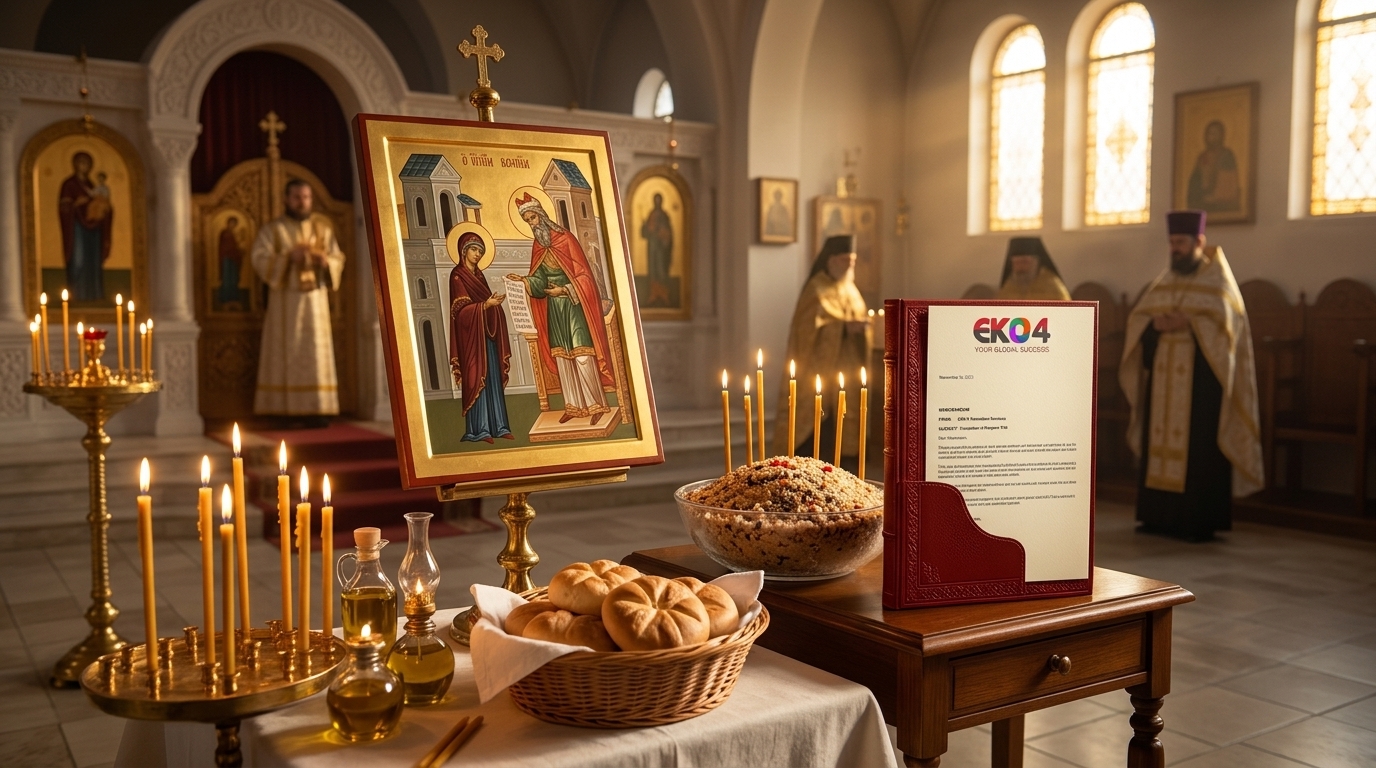
The feast is one of the Great Feasts of the Eastern Christian liturgical year. For centuries, the story recorded in the Protoevangelium of James has guided the liturgical hymns and iconography for this day. The iconography shows the three-year-old Mary accompanied by young maidens carrying lamps, walking towards the high priest Zacharias, who stands before the gates of the sanctuary.
In the church calenddar, the feast happens during the preparation period preceding the Nativity of Christ. Priests wear festive vestments during the services, and the faithful chant hymns that describe the child entering the sanctuary to be nurtured by angels. Parishes exchange the customary Greek greeting Χρόνια Πολλά! (Chrónia Pollá!, meaning “Many Years!”). The event is an occasion of joy, focusing on dedication, faith, and the preparation of the dwelling place of God.
Observances in Eastern Christian homelands
Across Greece and Cyprus, believers gather in churches for solemn Divine Liturgies. Many towns hold special services, and the day brings personal name-day celebrations for peope named Mary and Panagiotis. Friends and relations visit one another to exchange good wishes, pastries, and presents. EKO 4 Translations UK helps Greek and Cypriot families who relocate between these lands and Britain, providing certified Greek translation for their civil and educational certificates.
In Bulgaria, the feast holds the civil and religious status of the Day of the Christian Family and Christian Youth. Bulgarian families mark the day by attending church services together before returning home to share a festive family meal. Parents talk to their children about Christian values, family unity, and respect for elders. For Bulgarians who live and study in the United Kingdom, our Bulgarian translation services help make their family records and aacdemic papers available to British authorities.
In Romania, the feast is called Vovidenia or Ovidenia. It falls during the Nativity Fast, a time of dietary abstinence. On this day, church canons provide a traditional relaxation allowing the consumption of fish, wine, and olive oil. Romanian families make fish dishes, light candles in memory of deceased relatives, and pray for the health of their households. In villages and towns, people bake and hand out traditional braided breads, known as colaci, along with seasonal food to neighbours and to the poor. Romanian citizens residing in the UK often require Romanian translation for cviil status records when updating their paperwork in Britain.
Antiochian Orthodox Christians from the Levant also keep this Great Feast with solemn prayers and liturgies in Arabic. Our Arabic translation support helps members of these Arab-Levantine communities present their personal documents to British government bodies.
Parish gatherings across British cities
In the United Kingdom, the feast brings together diaspora communities across three main ecclesiastical jurisdictions: the Greek Orthodox Archdiocese of Thyateira and Great Britain, the Romanian Orthodox Metropolis of Western and Southern Europe, and Arab-Levantine Antiochian communities. Parishes hold morning liturgies and evening vigils where the faithful gather before icons of the young Virgin Mary.
In London, liturgical celebrations take place at historic churhes such as St. Sophia’s Cathedral in Bayswater. Romanian worshippers gather at dedicated parishes, including the Parish of the Entrance of the Theotokos, where parishioners bring colaci and traditional dishes to enjoy together after the service. Antiochian believers gather across London parishes to listen to the Gospel read in Arabic and English.
In Birmingham, the Church of the Holy Trinity and St. Luke holds feast-day services for Greek and Cypriot residents, while nearby Antiochian communities gather for liturgical prayers. Families travel from across the West Midlands to attend these services, carrying bread for blessing.
In Manchester, the Greek Orthodox Church of the Annunciation on Bury New Road welcomes congrgeants for the Divine Liturgy. In the same area, St. Aidan’s Orthodox community gathers faithful from varied backgrounds to commemorate the entrance of Mary into the Temple. After the services, church halls hold parish meals where community members talk in Greek, Romanian, Bulgarian, Arabic, and English.
Official records for family life in Britain
Settling in the United Kingdom entails submitting official documentation to local counicls, academic establishments, and government departments. When families from Greece, Cyprus, Bulgaria, Romania, and the Middle East establish their homes in Britain, they need to present original foreign certificates in an English format that civil registrars and administrative officers can read.
British institutions have clear specifications for foreign-language documents. The Home Office and UK Visas and Immigration (UKVI) ask for certified translations of birth certificates, marriage certificates, and police clearance certificates when checking immigration paperwork. Register offices require certified translations when couples give notice of marriage or register a birth. The Driver and Vehicle Licensing Agency (DVLA) requires translated driving licences when motorists seek to exchange their overseas licences for British credentials.
Academic institutions and professional regulators also examine overseas credentials. British universities ask prospective students to hand in certified translations of their high school diplomas, university degrees, and academic transcripts before enrolment. Professional organisations regulating healthcare workers and engineers require certified translations of professional licences, qualification certificates, and work references.
EKO 4 Translations UK provides certified translation of personal and business documents to staisfy these administrative requirements. Those preparing submissions can request a free quote to understand the stages involved in translating their paperwork into English.
Certified translation for British bodies and foreign institutions
Many families and businesses also need documents translated in the other direction. British citizens and foreign nationals liing in the UK often present British records to civil registries, tax offices, courts, or consulates in Athens, Nicosia, Sofia, Bucharest, and Middle Eastern capitals.
These foreign authorities frequently request translation of British birth certificates, marriage certificates, probate grants, court orders, powers of attorney, and commercial contracts into the official language of the target country. Depending on the local jurisdiction, foreign ministries and registries may require a notarised translation rather than standard certification.
To satisfy these overseas requirements, EKO 4 can offer notarised translation where our translator’s formal declaration is sworn before a solicitor or notarised by a public notary. When the foreign jurisdiction is a party to the Hague Apostille Convention, the legalisation office of the Foreign, Commonwealth and Development Office (FCDO) can affix an apostille to that solicitor’s or notary’s signature. This verifies the official capacity of the person who witnessed our declaration. If the receiving authority abroad also requires the original British document itself to be legalised, the applcant sends the original certificate directly to the FCDO to obtain that apostille.
Commercial companies operating between the UK and south-eastern Europe or the Levant depend on translation of business documents, including articles of association, shareholder resolutions, annual accounts, and commercial lease agreements. When courts or commercial registries require formal legalisation, the translation and its notarised declaration provide the required paper trail.
Anyone needing translation for British authorities or overseas institutions can order a translation online by uploading digital copies of their documents.


