




Saturday, 7 November 2026, is the day of Choti Diwali (Naraka Chaturdashi / Kali Chaudas). This celebration is the second day of the five-day Diwali festival period. It falls on the Chaturdashi, the fourteenth lunar day, of Krishna Paksha, the dark fortnight, in the Hindu lunar month of Ashvin, which corresponds to Kartika in the Purnimanta calendar. In 2026, the Chaturdashi tithi starts on the morning of Saturday, 7 November. In homes with roots in India, morning routines start with the greeting, छोटी दिवाली की हार्दिक शुभकामनाएं (Chhoti Diwali ki hardik shubhkamnayein – Happy Choti Diwali).
EKO 4 Translations UK helps families across Britain who have administrative links with India. The festive period draws households together for domestic preparations, temple visits, and family meals before the main Lakshmi Puja day. The occasion combines religious traditions with family life, both across India and in British towns and cities where Indian communities live.
The traditions of Naraka Chaturdashi
Naraka Chaturdashi commemorates the victory of Lord Krishna and Satyabhama over the demon king Narakasura. This victory resulted in the liberation of 16,000 impisoned maidens and ended demonic oppression. The day features rituals celebrating the removal of darkness and the restoration of order. In India, people clean their homes thoroughly in preparation for the evening festivities. They place earthen oil lamps, known as diyas, around courtyards and living rooms to light up the home.
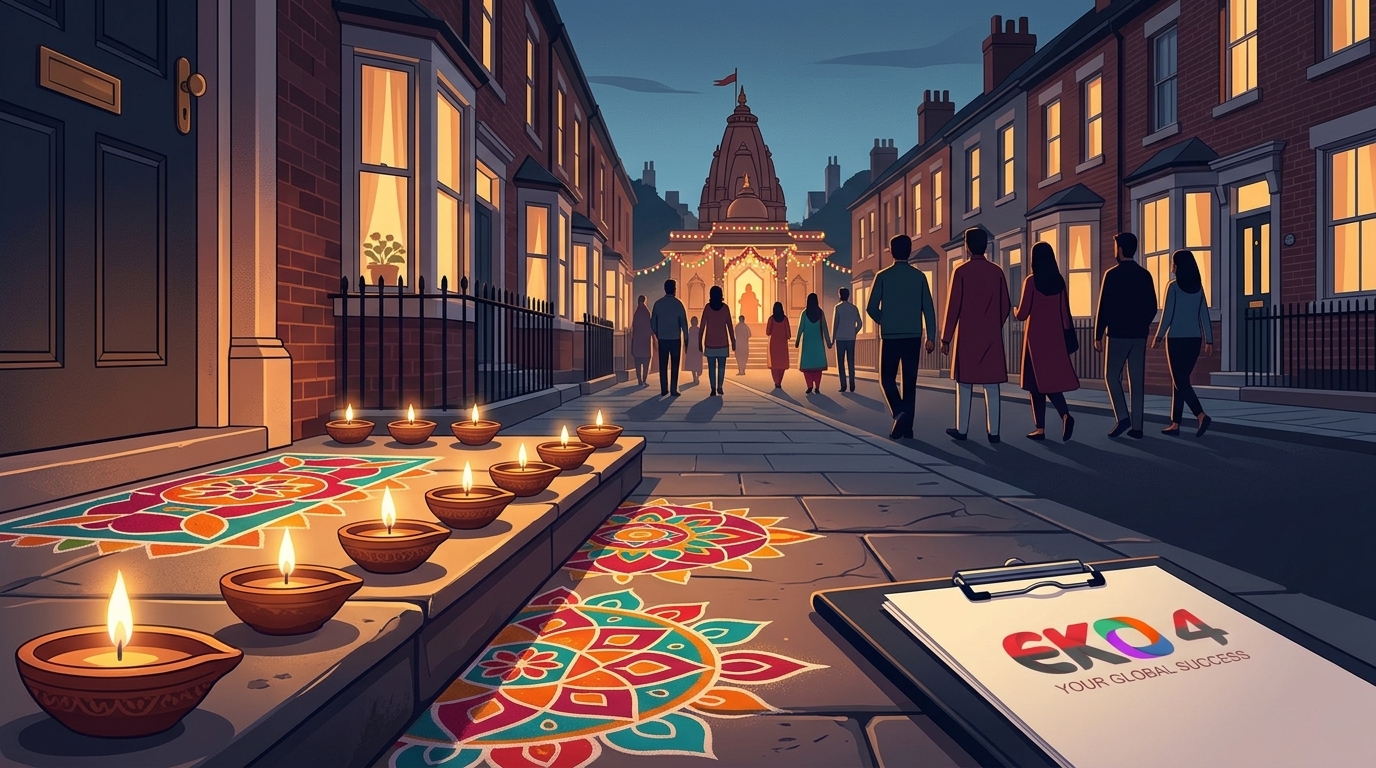
At house entrances, families make colourred rangoli patterns using tinted powders or flower petals. These geometric floor designs welcome guests and deities into the home. Festive sweets are prepared in domestic kitchens, and families set off fireworks in open courtyards as twilight falls. Religious recitations take place in family prayer rooms, held in regional Indian languages. For speakers of northern Indian tongues, our Hindi translation services help individuals who handle administrative records and legal papers between the UK and India.
Observances across Gujarat and western India
In Gujarat and western India, the day is celebrated as Kali Chaudas, holding distinct cultural weight within the regional calendar. Worshippers observe Kali Chaudas on the night of 7 November to worship Goddess Mahakali and Lord Hanuman. The purpose of these nocturnal prayers is to seek liberation from negative energies and malevolent forces. The observance centres on protective rites, where households direct their devotions towards overcoming internal and external fear.
Nocturnal prayers and oblations form the core of Kali Chaudas practices in Gujarati households. Families prepare specific food offerings, such as fried vada made from ground pulses and spices, which are ofefred during rituals to ward off misfortune. These offerings are put at designated points, such as road junctions or boundary walls, fllowing customary local guidelines. The culinary routines of the day also involve the preparation of regional savouries and confectionery that are shared among relatives. For members of the Gujarati diaspora who manage property papers and commercial agreements related to Gujarat, our specialised Gujarati translation helps individuals in presenting accurate records to statutory bodies.
Celebrations in British cities and mandirs
In the United Kingdom, Hindu and Gujarati diaspora populations observe Choti Diwali and Kali Chaudas extensively. Leicester is one of the main centres of activity, particularly along the Golden Mile on Belgrave Road. Shopfronts display festive goods, confectionery trays fill sweet shops, and residents place little oil lamps along residential windows. Community members visit local temples in the area, offering prayers and seeing friends before the major festivities of the subsequent day.
In London, observances happen across neighbourhoods with established Indian populations, such as Wembley, Harrow, and Neasden. Families go to services at mandirs, including the Neasden Temple, where evening prayers and darshan take place. In Birmingham, observances are held around the Jewellery Quarter and temple precincts across the West Midlands. Across these urban centres, families meet at community mandirs, light diyas at home, prepare traditional confectionery, and come together for fesitve celebrations that precede the main Lakshmi Puja day. These gatherings often bring together communities that speak different regional tongues, including those requiring Punjabi translation for academic records and personal certificates.
Translation requirements for families from India
For people living in Britain with ties to India, seasonal festivals offer an occasion to reflect on family history and civic responsibilities. Many people settle in the UK to study for university degrees or manage family businesses. Throughout these processes, public authorities in the United Kingdom require official records to be submitted in English. When certificates, transcripts, or identification documents are issued in Hindi, Gujarati, or Punjabi, they must undergo formal translation before processig.
British statutory bodies have clear specifications for submitted paperwork. The Home Office and UK Visas and Immigration (UKVI) ask for certified translations of birth certificates and marriage certificates for immigration paperwork. HM Passport Office asks for certified translations of parental documents and foreign passports when assessing passport applications. The Driver and Vehicle Licensing Agency (DVLA) asks for certified translations of foreign driving licences when individuals exchange their driving credentials. Register offices require foreign marriage or civil status records in English before conducting ceremonies. Universities assess academic diplomas and degree transcripts from Indian institutions during admission processes. UK employers and UK courts also require translated employment contracts and company filings.
The administrative process also works in reverse. British residents who manage property sales and ancestral inheritances in India rquire UK-issued documents translated into regional Indian languages. Power of attorney documents, death certificates issued in the UK, grant of probate records, and corporate resolutions must be translated into Hindi or Gujarati so that Indian municipal corporations, banks, and land registries can interpret them. EKO 4 provides certified translation and translation of persoal and business documents to help with these cross-border procedures.
Official certification for UK and overseas paperwork
Securing the right form of certification depends on the institution receiving the document. For most UK administrative bodies, including universities, register offices, and UKVI, a certified translation is needed. In this process, the translator or translation agency provides a formal declaration confirming that the translation is a true and complete representation of the original foreign document. This declaration includes the translator’s contact information, professional qualifications, and the date of completion.
In certain legal cases, a higher level of authentication is needed. When presenting documents to foreign embassies or judicial proceedings, authorities often ask for a notarised translation. For documents heading to authorities in India or other jurisdictions abroad that participate in international legal conventions, an apostille issued by the Foreign, Commonwealth and Development Office (FCDO) may be needed. EKO 4 organises the legalised route for our translations: our translator’s declaration is sworn before a solicitor or notarised, and the FCDO apostilles that signature on our translation. If an apostille is required on an original UK document, such as a British birth certificate or court order, the customer applies directly to the FCDO for it. Where an overseas body asks for a sworn translation, this legalised translation routte provides the equivalent formal recognition.
Individuals wishing to check requirements or discuss their documentation can request a free estimate for their translation needs. Those ready to go ahead with certifying their paperwork can order a translation online through the website.


